Billy has perked up, so we took a reasonably short walk along the river Ouche into the city of Dijon. Rich in architecture and with many shops, we spent time visiting the sites, with the odd stop for coffee! Bizarrely we didn’t buy any mustard!
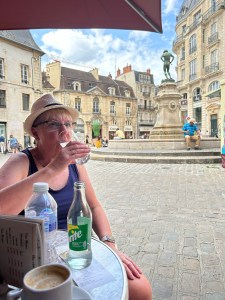
Known as the “City of Dukes,” Dijon was the capital of the medieval duchy of Burgundy. The center of town boasts a UNESCO World Heritage designation, because of its well-preserved aristocratic palaces and elegant ‘hôtels particuliers’, former residences of Dukes of Burgundy and other distinguished owners.
The Owl is the symbol of Dijon and there is an Owl Trail around the city. We managed, by chance, to follow this trail but going in reverse!
We visited many of the city’s sights including the Palais des Ducs et des États de Bourgogne, or the Palace of the Dukes of Burgundy. This was the residence of the Dukes of Burgundy in the 15th and 16th centuries. Renovations in the 17th century transformed the building into a refined Neoclassical palace that echoes the design of the Château de Versailles (designed by the same architect, Jules Hardouin-Mansart).
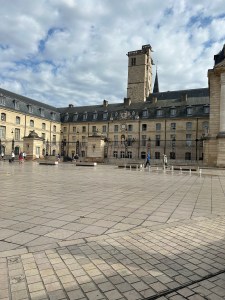
Today, the Palais des Ducs et des États de Bourgogne is used as the Hôtel de Ville (Town Hall).
Next was the 13th-century church of Notre Dame, a striking example of Gothic architecture, with a one-of-a-kind façade that features dozens of grotesques figures, some quite predictable, others downright strange. On the outside corner on Rue de la Chouette is the famous little stone carving of the owl and is said to bring good luck to those who touch it with their left hand.
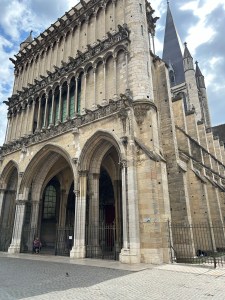

Keeping up the church theme, also visited the Cathédrale Saint-Bénigne. This is considered to be the city’s finest example of Burgundian Gothic architecture. Built between 1280 and 1314, the cathedral was originally a Benedictine abbey church. The cathedral is dedicated to Saint Benignus, who was martyred in Dijon in the late 2nd century.
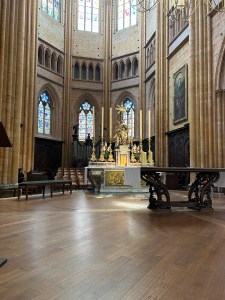
The only remaining participants of the original abbey is the “Rotonde,” a three-story subterranean crypt, which contains the relics of Saint Benignus. This solemn domed space dates to the 10th century (Carolingian era) and resembles the interior of the Church of the Holy Sepulchre in Jerusalem. Unfortunately it is currently being renovated and we couldn’t visit!
So a cultural visit, interspersed with a bit of window shopping and research into buying a French SIM card. We ended up buying a SIM at a tabac and can now get the WI-FI in the Brindley Boxer, running at speed, on the French phone network!!

 The Brindley Boxer