First an update. Billy seems much better today, had his appetite back and was almost back to his old self. So, we decided to leave Dijon and head to the Alps.
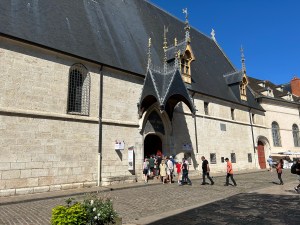
We headed off to Buene because it had been recommended. What a wonderful place. It’s a walled town at the center of the Burgundy winemaking region in France. Surrounded by the Côte d’Or vineyards, the cobbled town is renowned for an annual wine auction held at the Hôtel-Dieu (Hospices de Beaune). Recognized by its colorful, geometric-patterned tile roof, this 15th-century former hospital is now the Hôtel-Dieu Museum.
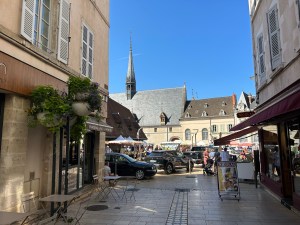
Beune is considered the capital of Burgundy wines. Every corner has a shop or wine caves selling expensive wines to every visitor.
In addition to the wine, Beaune is most famous for its hospital. Nicolas Rolin, Chancellor to Phillipe Le Bon, Duke of Burgundy and his wife, Guigone de Salins, founded Hospices de Beaune (or Hôtel-Dieu) in 1443. The Hundred Years’ War was ending and Burgundy was reeling from plague. This hospital served everyone in the region, regardless of their financial means, from 1452 through the 1960s. The Gothic-style building was inspired by the architecture in Flanders, and its colorful glazed tile roof is typical of Burgundy. This type of roof was a status symbol, dating to the 13th century when they adorned cathedrals. In the 14th century, they were en vogue with aristocrats.
From Beaune we ventured into the Alps. Deciding to go the quickest route did mean a 33 euro toll but it saved an hour or more in travel time (better for Billy we felt).
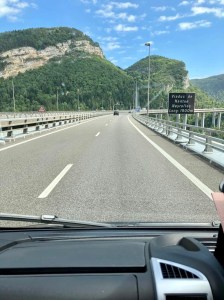
How impressive our introduction to this region. Long tunnels and soaring bridges/flyovers cut through the mountainside. The view up the mountains and down into the valleys far below was quite breath taking.

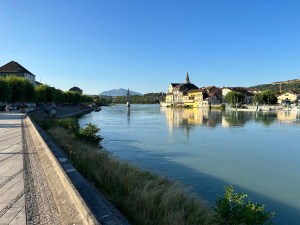
We stopped at an Aire in Seyssel an ancient town on the Rhône’s banks laying between the Bugey’s Grand Colombier Mountain and the Montagne du Prince in Savoie. There is little here but leisure activities centre in the water.
At 800 km long, the Rhône is one of the largest rivers in Europe. It has its source in the Swiss mountains. After crossing Valais, the river flows into Lake Geneva, then resumes its course to enter French territory. It finally flows into the Mediterranean.
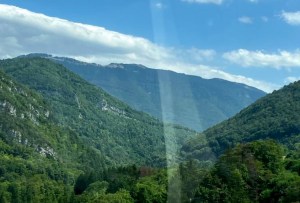
The history of this territory of the “Haut-Rhône” is therefore quite naturally linked to this river. Especially with a river trade that represented a very important economic activity until the 19th century.
We had dinner in the town amongst the locals. A lovely village straddling the Rhône with the Grand Colombier in the distance. The Colombier is a mountain in the Ain department in eastern France. The summit dominates the upper valley of the Rhône and the Lake of Bourget in the Savoie department and the commune of Culoz which lies at its feet.
 The Brindley Boxer