Rain! For the first time this trip we feel we have weather more usual in England. The hot sunny days are now behind us and we woke to heavy skies.
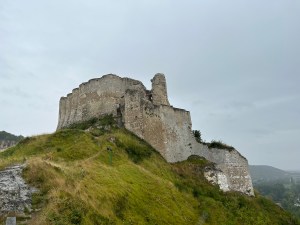
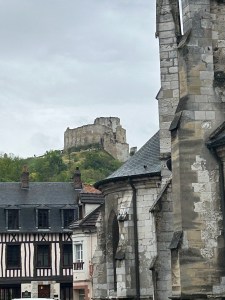
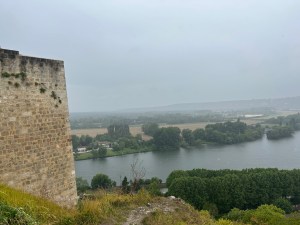
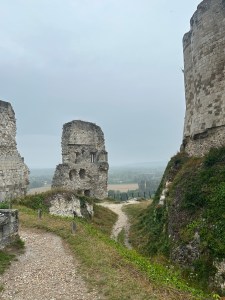
Not to be deterred, we walked from the campsite to Château-Gaillard. Considered a cutting-edge example of military architecture in its day, it was constructed by Richard the Lionheart in record time on the high chalk cliffs dominating a great meander in the River Seine. Today it is a ruin. The two villages we visited, that sit below, Le Grand Andely and Le Petit Andely, have merged to form one riverside village, Les Andelys, in the heart of an area of outstanding natural beauty.
Richard the Lionheart ruled a kingdom through his marriage that stretched from the Pyrenees to the Scottish borders, encompassing England, Normandy, Aquitaine, Poitiers, Maine and Anjou. He had the castle built to protect his Norman possessions, and its capital, Rouen. It took just two years, 1196-1198, some say possibly in only one, to build.
Richard and Philippe Auguste, the powerful French king of the day, had gone on Crusade together but they fell out on the way. History does not tell us why, but it hardly mattered since Richard died of gangrene after he was shot by a crossbow bolt in 1199. He was succeeded by his hapless, hopeless and helpless brother King John who would soon be landless as well (he is known by history as King John the Landless) since he lost both the castle and Normandy as a result!
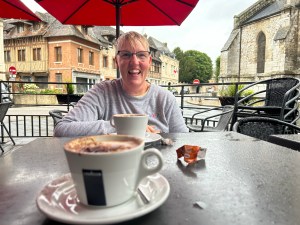
We tried to reclaim the castle by shouting “for England and St George” from the ramparts. Not sure we had any success, so settled for coffee in a very damp Les Andelys!
An early start and a generous journey as we left Brittany and headed into Normandy. First stop was a visit to Giverny and Monet’s house and gardens.
It seemed a good idea to take in some of the history from this famous impressionist painter. What we didn’t anticipate was the huge numbers that had the same idea!
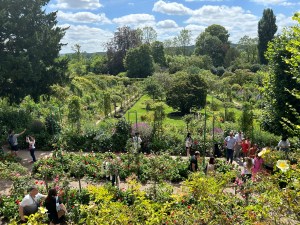
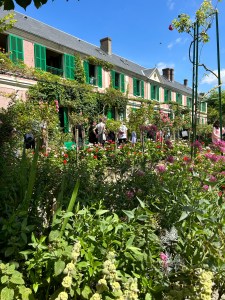
Wow – it was worth the queue! The house is brilliant and the gardens nothing short of spectacular. The flowers in full bloom on a warm summer’s day.
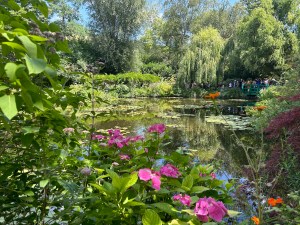
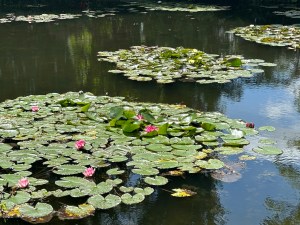
The lily pond, of so much fame, is stunning. A calm pond with flowering lilies surrounded by outstanding shrubbery. Oh and if you looked hard enough a couple of small boats, just as in Monet’s paintings.
For more than forty years, until Claude Monet’s death in 1926, Giverny was his home, his place of creation, and his work. A World of meaning, colors and memories, the house where the artist lived with his family, houses his living room-workshop and his collection of Japanese prints. The gardens are composed of the Clos Normand and its flower beds and the Jardin d’Eau, planted with oriental plants and weeping willows, with its Japanese bridge painted green and its water lilies.
Upon entering Monet’s house, you can imagine the house resonating with the sounds of the eight children, the comings and goings of Claude Monet between his workshop and the garden. It was a house centred around the kitchen, from the morning when the vegetables arrived fresh from the vegetable garden, to the arrivals of friends from Paris.
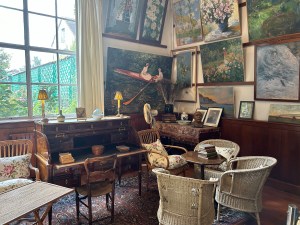
The reading room, also called the “small blue room”, which links with the “grocery store” where tea, olive oil, spices and eggs were stored, hanging from the wall. Then there is the artist’s first studio, where he worked until 1899. About sixty paintings were selected to be replicated. These replicas are now hanging on the walls of the salon-workshop.
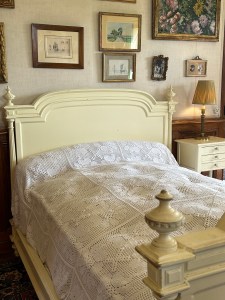
A first staircase leads to the floor that serves the private rooms. Monet’s room, bathroom, and Alice’s bedroom, which overlooks a tiny room intended for sewing work. Bridesmaid tablecloths sewn together line the walls of the two bedrooms.
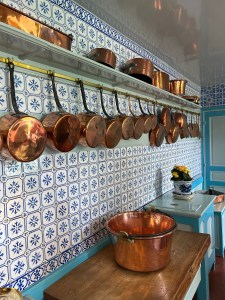
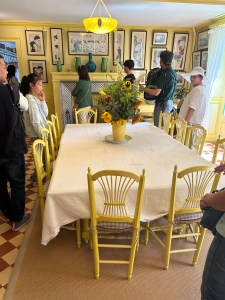
Back downstairs, the dining room of the house has been reconstructed in every detail. On the yellow walls, you can see Monet’s collection of Japanese prints. The furniture painted in yellow was very modern for the time. In the windows there are blue earthenware dishes, the yellow and blue service, that Monet had made for the holidays. In the blue-checked kitchen, the huge multi-stove stove and copper utensils seem to be waiting for the return of their owners.
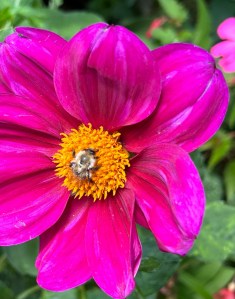
An outstanding house and gardens lived in by one of the foremost impressionist painters. Even the wildlife enjoy this impressive place!
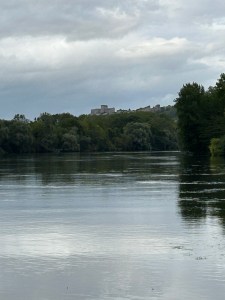
At the end of an excellent day, we landed at our campsite; Château Bouafles. Nestled in the valley on the river Seine with a view, down the river, to Château-Gaillard in the far distance.
Lazy start and short hop to the historic town of Vitré in central Brittany, about 25 kilometres east of Rennes in the Ille-et-Vilaine department. Vitré has a very attractive and well maintained old-town centre with lots of narrow streets lined with medieval cottages and also a magnificent castle and some believe the most impressive medieval town in Brittany.
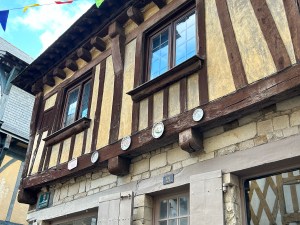
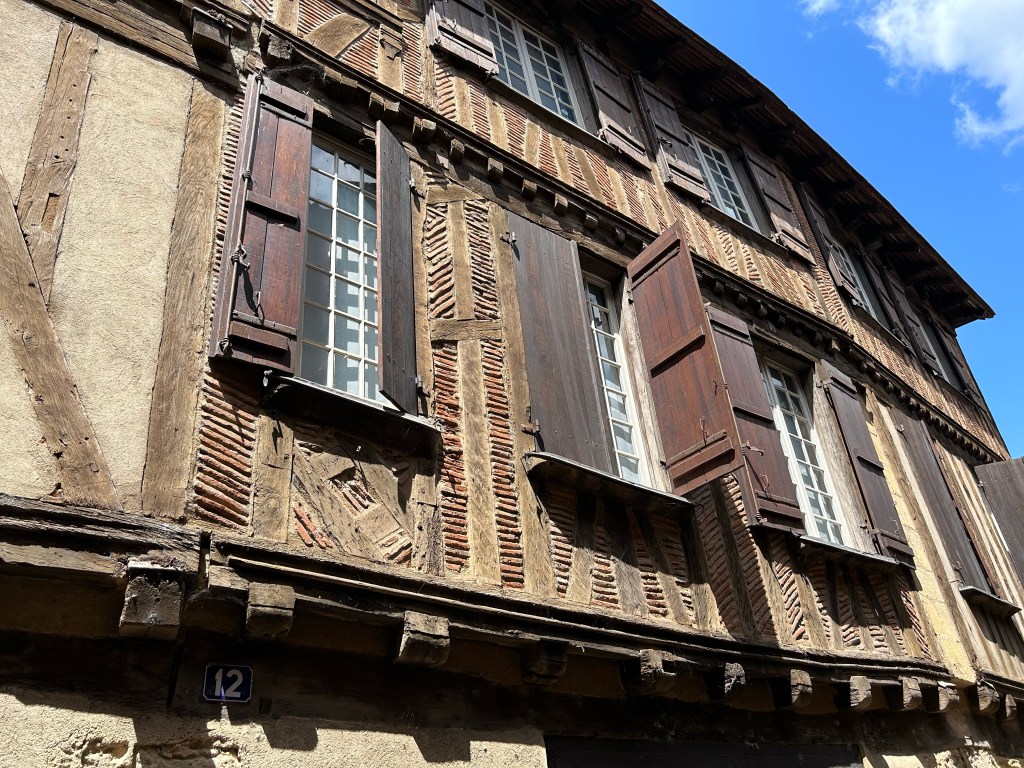
In the old town there were a large number of lovely colombage (half-timbered) houses. It is little surprise to find that the town is a listed “Art and Heritage town” and has many 15th and 16th century buildings remaining much as they were in the days when it was one of the most powerful towns in Brittany. We walked around the original ramparts of the town which are mostly intact.
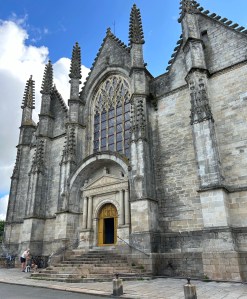
Among the monuments in the centre we found the attractive 15th century Church of Notre-Dame, with it’s recognisable decorated spire. The church is an interesting example of the Flamboyant Gothic style and also contains interesting items including an impressive stained glass window.
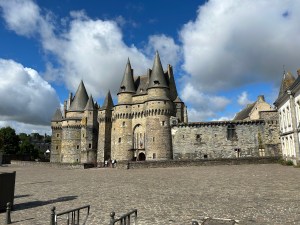
Vitré is famous for its castle, built in the 13th century and with many additions to the fortifications in the following centuries. The castle is an imposing building with many towers inset in the high walls and reached across a drawbridge. The Chateau is unusual in that, with its attached buildings, it has been built in a triangular pattern. This is because of the shape of the raised rocky area it was built on.
Vitré was a pleasure to explore with its medieval centre, particularly the streets of Rue de la Beaudrairie (street of people who worked with leather), the Rue de la Poterie and the Rue du Chateau.
We then took a short hop (49 mins) to Fougères and found our campsite. Lunch while we waited for the site to open and then off to explore!
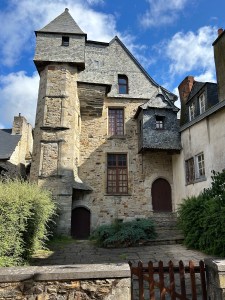
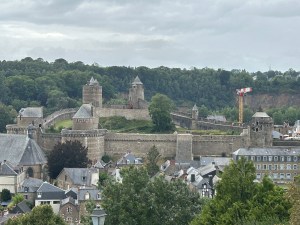
The drive into Fougères, is dominated by an impressive granite silhouette that dominates the town upon which sits a large castle founded in 1020. Nestled at the foot of the largest fortress in Europe, is the town with its half-timbered houses and cobbled streets, a reminder of the town’s wealthy past.
It was harder to see the castle from within the town. But after some walking up and down hills, it did finally manage to reveal itself.
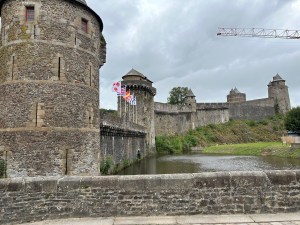
Standing on a spur of shale, Fougères castle, a large defensive complex was built between the 12th and 15th centuries. Flanked with 13 towers over an area of two hectares, its fortifications, which were once surrounded with water, have been completely restored.
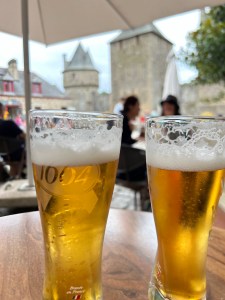
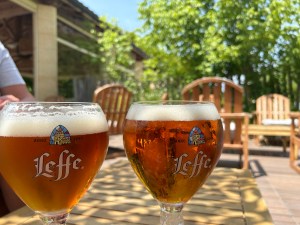
A beer outside the castle was more than welcome. From this close you can begin to appreciate the amount of land these towers and walls cover.
A damp start to the day. The first real rain we’ve had this trip. But baguette and croissants from the local shop for breakfast and we were off to find the vets.
Billy needed to have documented tapeworm treatment for our return to the UK. So we found a vet in Nantes. 40 euros later we had the tablet administered, Billy checked and all the necessary paperwork signed and stamped.
Morning coffees were taken by a large hypermarket in Châteaubriant. A bit of food shopping and more fuel for the Brindley Boxer, then on our way to Le Pertre.
Eglise Saint Martin
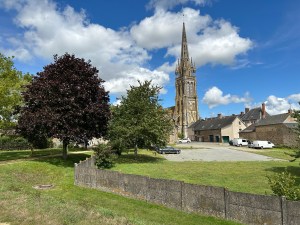
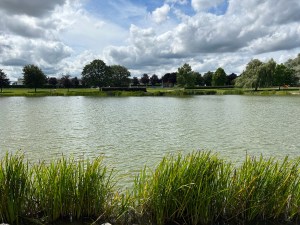
After the hustle and bustle of Nantes it was nice to travel through the countryside and land in a quaint little village on a lovely little Aire. Set next to a lake and with little more than a church in the village, it was certainly a severe change in pace!
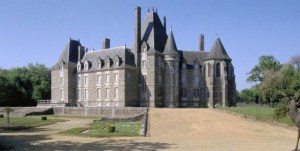
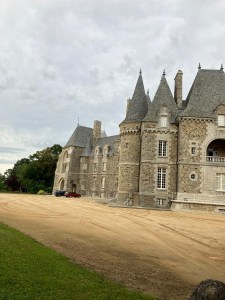
An evening walk after supper to Château Bel-Air. The Château as it is today, is the result of two reconstructions. It is located on the site of an old mansion that belonged to the Charil de la Rousselière from 1516 and which passed to an English merchant, called Legge, who came to France in 1608. The old mansion was flanked by a square tower and a dovecote, decorated with 2 French gardens. Rather than reconstructing it, Louis de Legge commissioned Jacques Mellet, architect of Rennes, to reconstruct it from 1870 to 1873. The new building, with a neo-Gothic look, is composed of 2 perpendicular pavilions widely pierced and castellized by the diagonal flanking of two pepper towers.
Paul de Legge, son of Louis de Legge, decided in 1910 to rebuild the family castle and called on Henri Mellet, son of Jacques Mellet, and Jean-Marie Huchet being an entrepreneur. The latter triples the surface of the old building and adds to the 1873 castle a central pavilion, some towers, the wing of the chapel and the chapel itself.
The prestigious castle, a symbol of reactionary political resistance, was completed between 1910 and 1921. The iconography of the chapel includes portraits against the personalities then in power of radical and republican France.
We left the busy Aire de Camping Car at La Rochelle and took a risk on parking up in Nantes. As we headed for a small Aire in the city, it was touch and go on whether we would bag one of only 15 pitches!
The van decided that it needed Ad Blue half way there. So another exciting adventure as we came off the motorway to fill up with the required additive. After figuring out how to use an out of service pump (took us a few drives round the motorway service station) we finally got what we needed and got on our way.
The Aire showed zero availability and when we arrived there were 2 vans waiting to enter! Fearing a washout and looking at alternatives when a German called the company because there were free pitches. After a short wait, we got in! Sharon’s plan had come to fruition, we just needed to get into the heart of the city!
There was a bus available from outside the Aire so on we hopped on. Had to carry Billy! He wasn’t impressed but was so well behaved and particularly as it was the hottest bus ride imaginable!
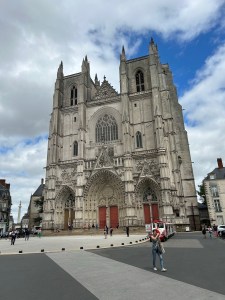
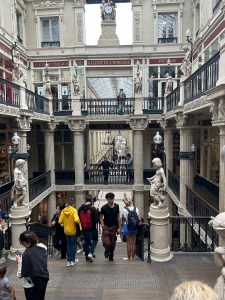
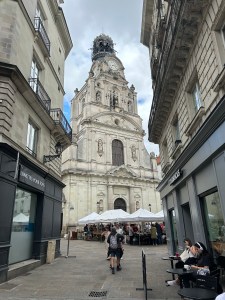
There is a green line painted on the ground that leads you around the heart of the city. It passes all the cultural areas of interest, the main monuments, the works of art and some of the unique things to see. We vaguely followed the line and took in the major sites.
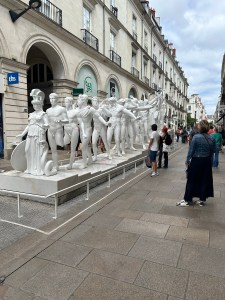
Our journey through the city included a stop for a cappuccino, that arrived disguised as a hot chocolate! There was also some strange artwork hidden in the main eating/shopping area.
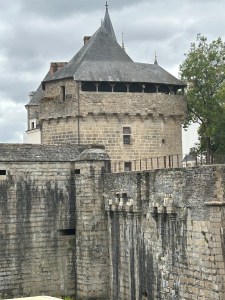
Nantes sits on the Loire River in the Upper Brittany region of western France, and has a long history as a port and industrial center. It’s home to the restored, medieval Château des Ducs de Bretagne, where the Dukes of Brittany once lived. The castle is now a local history museum with multimedia exhibits, as well as a walkway atop its fortified ramparts.
Not the best city we’ve visited but it did have a little charm, once you found the heart of the place.
Prompt start and slow drive to La Rochelle. Skipped morning coffee to arrive at a large Aire in the city. Fantastic that the municipality arrange such good motorhome stop off areas.
After a spot of lunch, a wander along the sea front to the harbour side.
La Rochelle is a coastal city in southwestern France and capital of the Charente-Maritime department. It’s been a center for fishing and trade since the 12th century, a maritime tradition that’s reflected in its Vieux Port (old harbor) and huge, modern Les Minimes marina. The old town has half-timbered medieval houses and Renaissance architecture, including passageways covered by 17th-century arches.
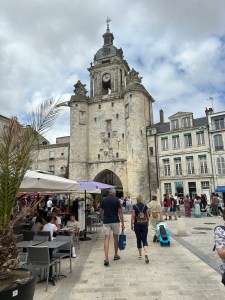
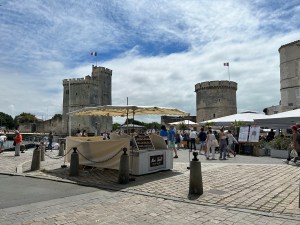
The harbour is guarded by a stone wall, with the entrance flanked on either side by large fortified towers.
Around the quayside were masses of cafes and restaurants. It was a busy bustling place and although walking into town gave some respite, it still remained the busiest place we have visited in this trip.
Coffee on the harbour side
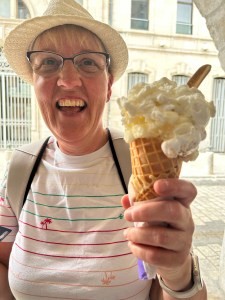
Sharon found an amazing, and extremely popular, marchand de glace and bought herself a massive lemon meringue and coconut ice cream!
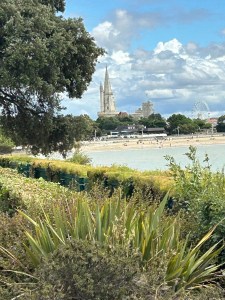
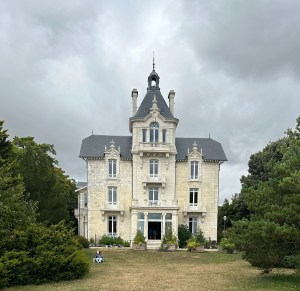
Even the walk back to the Aire didn’t disappoint, as we walked behind the sea front through Parc Franck Delmas. More French architecture revealed itself. Within the 6.2 hectares park a bourgeois house, owned by the former masters of the place, sits in the heart of wooded paths and various plant developments. The park very rich in holm oaks, has a collection of conifers and integrates the types of plant found in ancient Mediterranean gardens. Like the shipowners’ gardens, it was completed with plants that travelling botanists brought back from their journeys.
Finally it is worth mentioning the key theme of our visit – electric hook up! There aren’t enough outlets for all the vans to connect too. So, the outlet next to our van was in use by Motorhomes deploying extension leads to pitches along way from ours. After the disappointment of not plugging in (not that we needed too, but it was the principle) as we sat for an evening cuppa an outlet became free! Oh the joy 🤣 ⚡️
Back on the road today headed northwest’ish and left the Dordogne behind. A beautiful drive through the Dordogne region. Some spectacular villages en route and more than the odd chateaux!
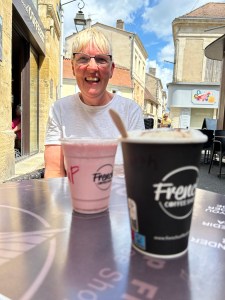
First stop Bergerac. Didn’t know what to expect from what at first appeared to be quite an industrial town. Parked up thanks to Sharon’s expert guidance, headed for the historic old town. Found a nice quiet cafe for our usual coffee. Sharon cheated today and opted for the strawberry milkshake!
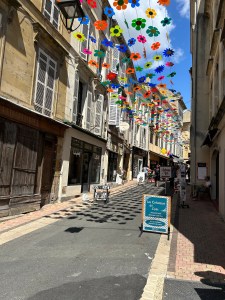
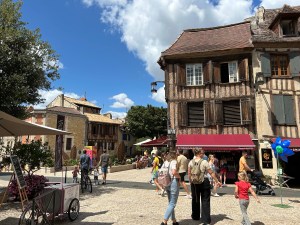
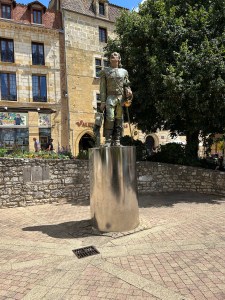
The historic old town was busy and tourists flocked to the river for boat trips, the statues of Cyrano de Bergerac, the wine caves, and the Cloître des Récollets, a 17th-century cloister.
To give this famous Frenchman his full name – Savinien de Cyrano de Bergerac (6 March 1619 – 28 July 1655) was a French novelist, playwright, epistolarian (a writer of letters), and duelist. A bold and innovative author, his work was part of the libertine literature of the first half of the 17th century. Today, he is best known as the inspiration for Edmond Rostand’s most noted drama, Cyrano de Bergerac (1897), which, although it includes elements of his life, also contains invention and myth.
We did pass the Musée de Tabac documenting the history of tobacco but never took a peak inside.
We lunched in a picnic area on baguette with camembert and a creamy goat cheese flavoured with pumpkin seeds and red peppers. All washed down with an English cuppa!
Finally we arrived at our campsite near Le Fouilloux for the night. Camping La Motte, a quiet site with a mixture of cabins, mobiles and camping pitches. Not a standout site but it does have a small covered swimming pool, fresh baguettes and croissants in the morning.
Le Fouilloux is a commune in the Charente-Maritime department in southwestern France. The nearest largish town to the west is Montguyon.
Well that was a surprise! A stormy night with heavy rain and thunder and lightening. Flashes of lightening rolled around the valley lighting up the sky every few seconds and creating chaos for those in their tents. For us there was no drama, as we rolled over and went back to sleep 💤.
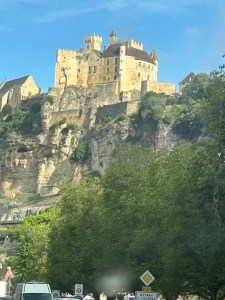
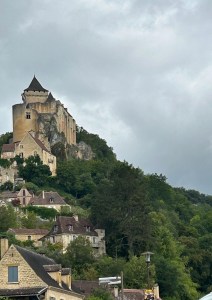
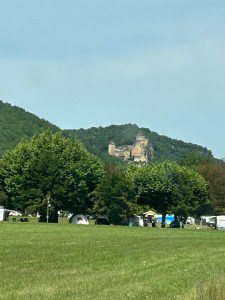
The day started damp but again very warm. After a very lazy start and breakfast outside, we ventured to the village of Castelnaud-la-Chapelle. A short walk and the cloudy morning made it a pleasant stroll. The big attraction is Chateau Castelnaud, a huge fortress high on the hillside and dominating the area. Our morning coffee was taken at the bottom of the village in the shadow of this striking building.
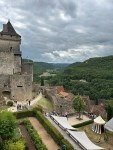
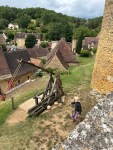
Built on a rocky outcrop in the heart of the Périgord Noir, 9km from Sarlat, Castelnaud Castle offers a magnificent panoramic view over the Dordogne Valley. Built in the 12th century, it is a perfect example of a medieval fortress. Today, the castle houses a large collection of weapons and armour. Along the bastion, the most powerful siege engines from the Middle Ages have been recreated and placed in attack positions.
It was a climb to the Castle itself but worth every step. There was so much to see and the views were spectacular. This picturesquely restored castle, a private property open to the public, houses a much-visited museum of medieval warfare, featuring reconstructions of siege engines, mangonneaux, and trebuchets. The castle is listed as a monument historique by the French Ministry of Culture.
Having climbed, explored, and descended, Sharon popped into the patisserie for a cheeky cake. There were so many to choose from but this ‘Mademoiselle Tonka’, a chocolate laden, caramel delight, was her choice and it went down a treat! 😋
Spent the early evening with Sheila and Dave. Fellow Warwick XL owners. It was nice to meet them and swap ideas on places to visit and changes that could be made to the van! We thought our three weeks in France was an adventure. They are well into six months way. Now in France having been down to Spain and Portugal!
A lazy start and a short hop to Brive-la-Gaillarde. Easy parking on a Sunday and a chance for more coffee and pastries.
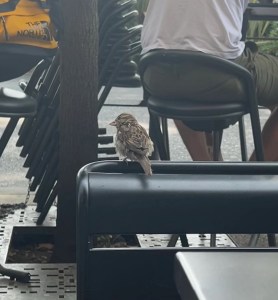
Such a pleasant morning. Even the sparrows came to join us for nibbles.
We had a stroll around the town. Brive-la-Gaillarde is known for its large food market held three times a week in Georges Brassens Hall. The former home of WWII Resistance activist Edmond Michelet is now a museum focusing on the wartime period. The Labenche Art and History Museum displays Mortlake and Aubusson tapestries. Dating from the 12th century, St. Martin’s Collegiate Church has a neo-Romanesque bell tower.
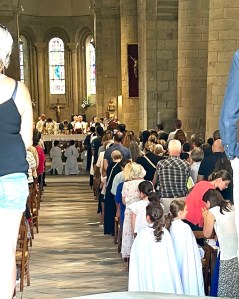
We managed a peak inside the church during Sunday morning worship. The church was very full and the heady aroma of incense punctuated by the sound of the church bells. It was quite some experience.
We then tackled the winding roads through the Dordogne towards our campsite. The change in scenery was very noticeable. Much greener and less humid, despite a temperature of 30 degrees.
The Dordogne is a French department of the Nouvelle-Aquitaine region largely corresponding to the Périgord, located in the southwestern quarter of France. It owes its name to the river of the same name that crosses it.
We arrived at Camping Maisonneuve. Since 1964, the Dejean family has been welcoming visitors to Camping here, their corner of paradise, set in the heart of the Périgord Noir in the Dordogne. For 55 years they have shared, friendship, love, dreams but also obstacles, progress, inspiration and traditions… all in an authentic setting to make unforgettable holidays for others in the Dordogne.
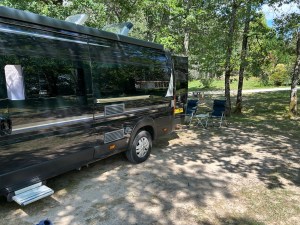
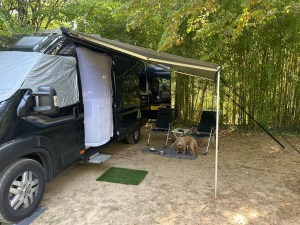
This is an exceptional campsite located on the banks of the “Le Céou” river that crosses the campsite. This river is exceptionally clear and clean. We set our little pitch for a couple of nights on one of about 50 pitches by the river. There is also a swimming area for campers at the bottom of the campsite so that the river is accessible to those who do not have pitches by the water. Apparently the water is replenished by sources that give it an exceptional clarity and does not attract mosquitoes.
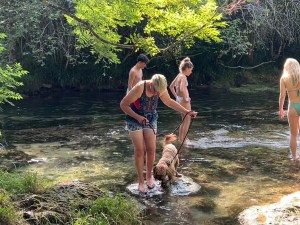
Sharon and Billy ventured into the shallows to test the water. Billy’s not a keen swimmer but he was pleased to cool off from the heat. There were so many families out swimming, using inflatables or canoeing, and even some fishing from the back of their tents and caravans. It is easy to see why this is such a popular place to holiday.
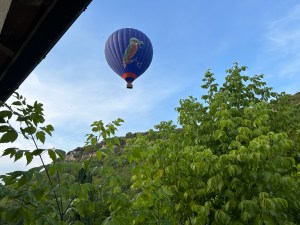
Dinner in the restaurant finished a pleasant day. Duck breast for Sharon and baked Camembert for me; delicious. A number of balloons flew past as we ate. A very nice end to a very nice day.



 The Brindley Boxer